Scenario-Based Merchandiser Training
A learning prototype built around realistic frontline decisions.
Frontline employees rarely perform their work in perfect conditions. They encounter competing priorities, incomplete information, changing inventory, customer needs, time pressure, and local variation.
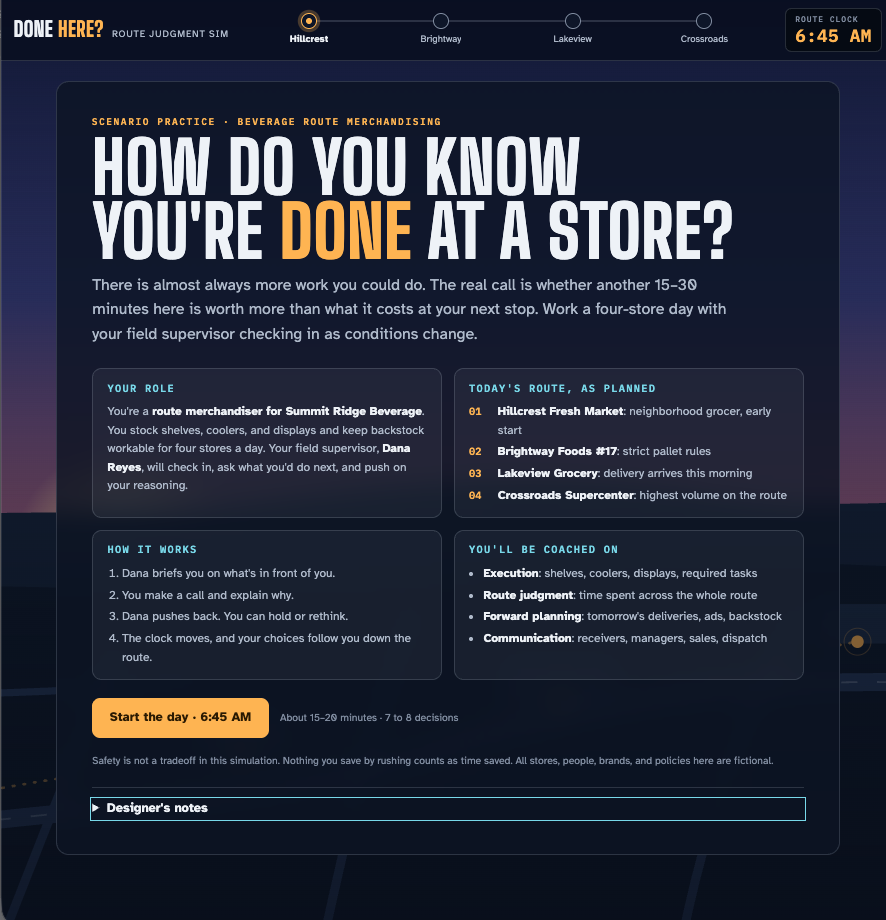
This independently developed learning prototype demonstrates how scenario-based training can help retail merchandisers practice judgment in realistic work situations.
The prototype is fictionalized and does not contain confidential information, proprietary processes, or internal materials from any employer.
The Learning Need
Traditional training often explains policies and procedures but gives learners limited opportunity to practice applying them.
A merchandiser may understand the expected standard and still struggle when confronted with situations such as:
limited shelf or display space;
missing or delayed inventory;
competing store priorities;
unclear communication;
time pressure;
unexpected product conditions;
requests that conflict with established expectations.
The learning need is therefore not simply knowledge. It is sound judgment under realistic constraints.
The Design Goal
The goal of the prototype was to create a short, practical learning experience that:
reflects the realities of frontline retail work;
allows learners to make decisions;
provides immediate, constructive feedback;
demonstrates the consequences of different choices;
reinforces principles without becoming overly procedural;
can be completed in a limited amount of time.
The Approach
Begin with a recognizable situation
The scenario places the learner in a plausible store environment with a clear responsibility and an emerging problem.
The learner receives enough context to make a decision but not so much information that the situation becomes artificial.
Require a meaningful choice
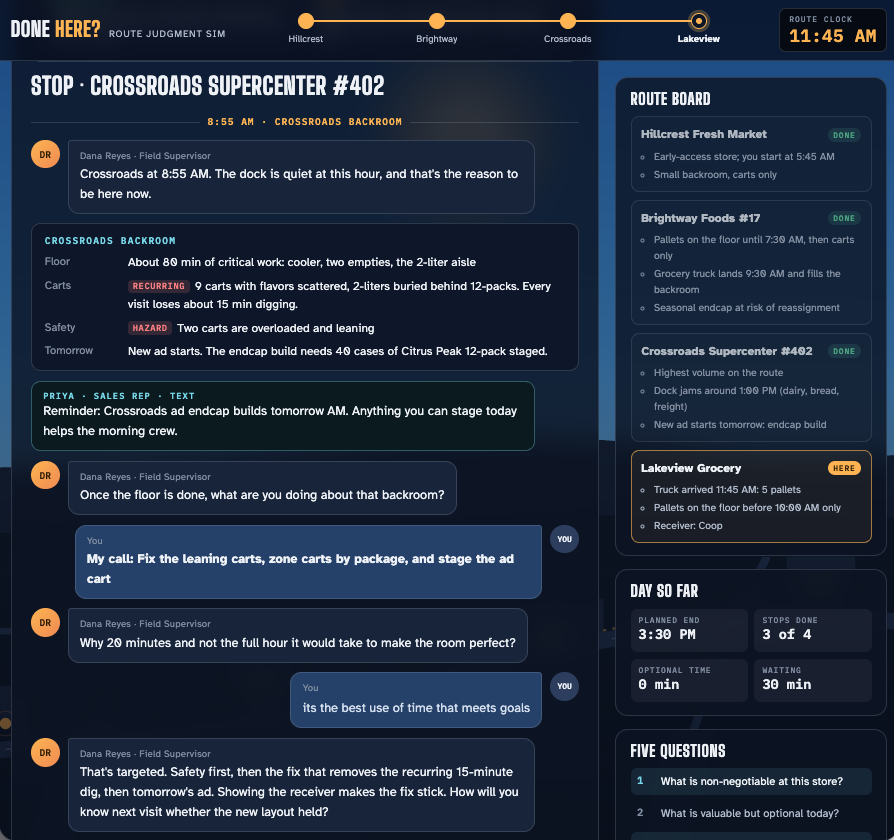
Rather than clicking through content, the learner must choose among several possible responses.
The alternatives are designed to be credible. An obviously absurd answer does not create meaningful practice.
Provide feedback that explains the reasoning
Feedback does more than label a response correct or incorrect.
It explains:
why the choice may or may not work;
who could be affected;
what principle should guide the decision;
what a stronger response might include.
Show consequences
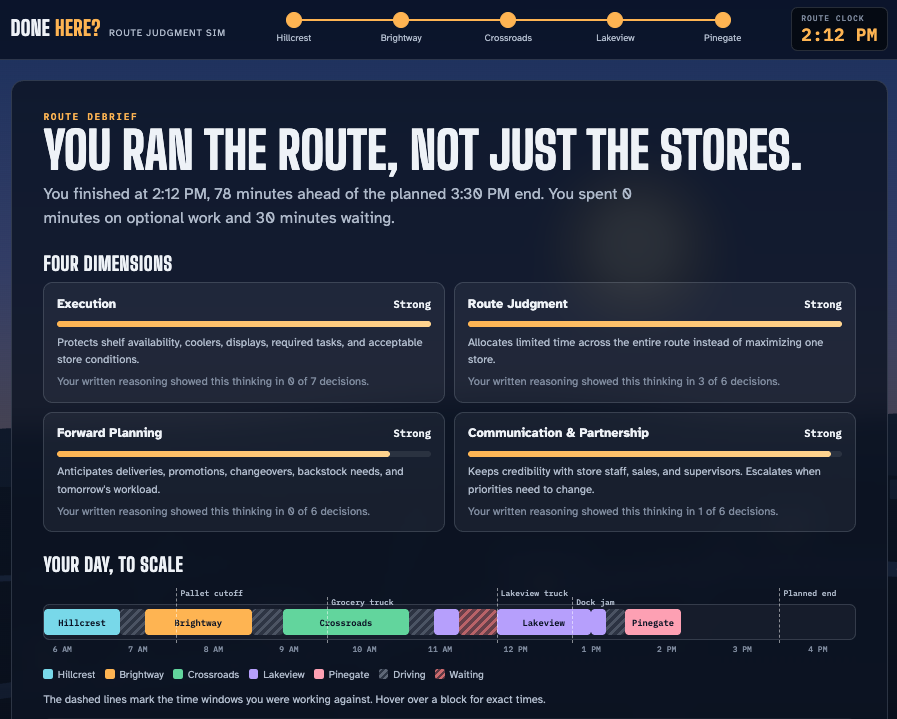
The scenario helps learners see that frontline decisions affect more than task completion.
They can influence:
product availability;
store relationships;
customer experience;
safety;
time and productivity;
communication;
trust and reliability.
Keep the visual design functional
The visual approach is intentionally restrained.
The interface supports the decision rather than competing with it. The prototype demonstrates instructional structure, scenario logic, feedback design, and learner flow rather than advanced illustration or video production.
The Outcome
The completed prototype demonstrates how a short digital learning experience can:
place employees in realistic situations;
build decision-making capability;
connect principles to frontline behavior;
provide safe practice before real-world consequences;
support consistent judgment across distributed teams.
What This Work Demonstrates
Scenario-based learning
Frontline performance support
Adult learning
Decision practice
Feedback design
Articulate Storyline development
Retail and distributed-work context
Practical learning design
The purpose of scenario-based learning is not to make training entertaining. It is to give people a safe place to practice the decisions their work will require.